

- Home
- CLA Annual Meeting 2026
Using AI in your practice?
California's new AI rules for lawyers, and what they mean for your firm's technology.
SB 574 takes effect January 1, 2027. It sets out how attorneys may use generative AI, and it covers the tools your team uses every day. We'll be at the CLA Annual Meeting all three days. Stop by our table for 15 minutes and we'll walk you through it.
Most firms already use AI. SB 574 asks you to know where.
The news has focused on fake citations. The rule we'd look at first is the one about client data, because it depends on how your tools are set up.
Most AI users bring their own tools to work. Unless someone says which tools are fine for client matters, each person decides.
Research platforms, word processors and email now draft and summarize. Many firms use AI without ever choosing to.
SB 574 keeps confidential and personal information out of any AI tool unless access is restricted to your firm. Many free tools learn from what people type.
Under the new citation rule, the firm, not only the lawyer who filed, answers for its people's mistakes.

The six rules, in plain English
Here's what each rule asks of you, without the legal language.
For every attorney who uses AI
Keep the judgment
AI can help with research and drafts. The legal judgment stays with the lawyer.
- The one we'd look at first
Protect client data
Keep confidential, personal identifying and other nonpublic information out of any AI system unless access is restricted to you and people you authorize.
Check the output
Check what AI produces, including every case and statute it cites, and fix any errors before you use it.
Tell the court
Say so when AI helped with a document you file. Consider a note on articles and posts you publish.
For court filings
Check every citation yourself
The responsible attorney personally checks every citation in a court filing, wherever it came from.
The firm shares the risk
In most cases, the firm is jointly responsible when one of its lawyers or staff breaks the citation rule.
What ready looks like on January 1
Set up well, AI saves your people hours and stays inside the rules. Here's what that looks like day to day.
Client data stays in tools you control
Firm-owned AI accounts, access limited to your people, and settings that keep what you type out of training where the provider allows it.
Every filing is easy to check
A short citation log and one disclosure line, used the same way every time and saved with the matter.
You can show your work
When a court, a client, an insurer or the State Bar asks how you control AI, you hand them the policy, the training records and the reports.
SB 574 at a glance
The numbers from our guide, each tied to its source.
- 6
rules for attorneys and firms: four duties, a citation check and shared firm responsibility.
- 9
kinds of personal information the law names, from dates of birth to account numbers.
- 75
Assembly members voted for it, and none against. The Senate passed it 39 to 0.
What One82's managed AI service covers
Whether client data is protected comes down to how your AI tools are set up. We take care of that every month, the same way we take care of backups and updates.
- 01
AI acceptable use policy
Written for your firm: approved tools, what client data can go in, and how output gets checked. Signed by every employee and updated when tools or rules change.
- 02
AI app control
We agree with you on which AI apps run on firm devices. Approved apps are installed and set up for you. Others stay off until you approve them.
- 03
Client data rules
Settings on each laptop and in email that keep client data in the tools you approved.
- 04
Firm-owned AI accounts
Business accounts your firm controls, with access limited to your people and inputs kept out of training where the provider allows it.
- 05
Lawyer and staff training
Training by role at onboarding and on a schedule, refreshed as tools change. Records kept for when you need to show them.
- 06
Visibility and reporting
A regular report on which AI tools are in use, by whom, and what changed. Unapproved AI shows up early.
- 07
Vendor AI review
When a vendor adds AI to software that holds client data, we review the terms and settings with you before your team turns it on.
- 08
Quarterly review
We meet on new tools, new rules like SB 574, and what's working. Your policy and controls stay current.
Three steps to being ready by January 1
- 1
Book 15 minutes
At our table in San Diego, or by video the week after. Tell us which AI tools your team uses today, even if the honest answer is "we're not sure."
- 2
Get your free assessment
We find every AI tool in use, including AI inside software you already license, and check each one against SB 574's restricted-access standard. No cost and no obligation.
- 3
Be ready on January 1
We put the policy, controls and training in place, then keep them current as the tools and the rules change.
Let's talk. Book 15 minutes with One82.
Have questions about IT, AI, cybersecurity, compliance, or how your firm can become more visible in AI-powered search? We'd love to connect.
Farzon, Mike, and Lou will be at the One82 table throughout the conference, ready to exchange ideas, answer questions, and explore opportunities for your firm.
Choose a time that works for you, and we'll send you a calendar invitation. No preparation needed, just bring your questions!
- Thursday, October 22Noon to 8:00 PM
- Friday, October 239:00 AM to 8:30 PM
- Saturday, October 248:00 AM to 1:00 PM
Sheraton San Diego Resort, at the One82 table in the CLA Annual Meeting exhibit hall
 Farzon AlmaneihFounder and CEO
 Mike NottoliBusiness Development
 Lou LambVP Marketing & Operations
Calendar not showing? Open the booking page
SB 574 questions from law firms
We don't use AI. Does SB 574 apply to us?
Probably. AI is now built into everyday legal tools: research platforms, word processors, email and document review. The citation rule also covers every citation in a court filing, whatever its source. Our assessment shows you where AI already runs in your firm.
Can we still use AI for legal work?
Yes. AI can help with research, drafting, document review and correspondence. The law keeps the judgment with the lawyer and asks you to check what the AI produces.
We strip client names before using AI. Isn't that enough?
Not on its own. The rule also covers dates of birth, addresses, financial information, account numbers and anything confidential or nonpublic. The simpler path is a tool where access is restricted to your firm.
A paralegal checks our citations. Are we covered?
Holland & Knight's reading is that the responsible attorney can't rely only on someone else's check. A short citation log with each filing helps: who pulled each authority, who read it, and when the attorney signed off.
Is it the filing lawyer's responsibility, or the firm's?
Both. Absent exceptional circumstances, the firm is jointly responsible for violations by its partners, associates and employees. That's why the controls belong in the firm's technology, not only in a policy.
What happens in 15 minutes at your table?
You tell us how your firm uses AI today. We tell you what SB 574 asks of your technology and where firms like yours usually start. If it makes sense, we schedule a free assessment for after the show.
Is this legal advice?
No. This page and our guide are general information. We handle the technology side: the tools, the settings, the controls and the records. Confirm your legal obligations with your counsel or ethics advisor.
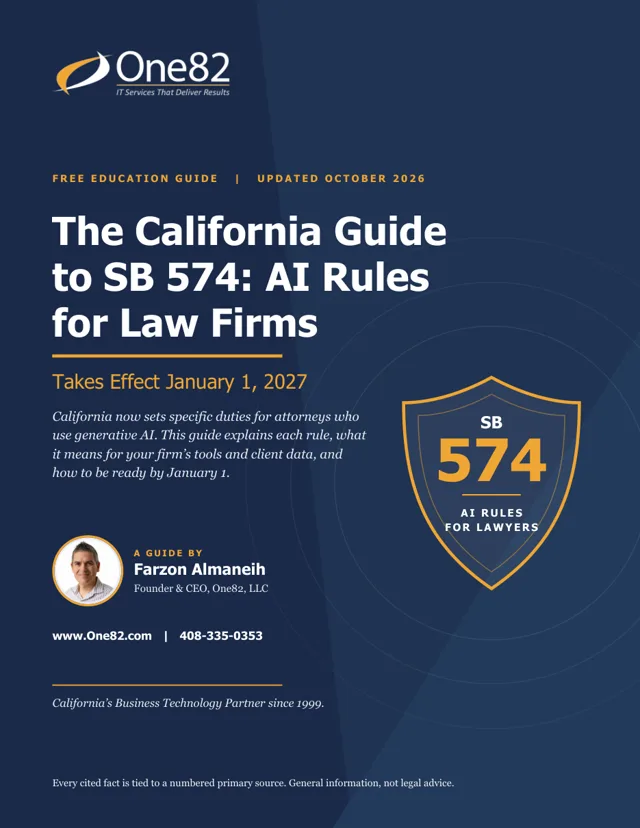
The California Guide to SB 574: AI Rules for Law Firms
Not ready to talk yet? Read the rules first. Our guide covers each rule in plain English, with every fact tied to its source.
- The six rules and where each one lives in the Code
- A seven-question check for any AI tool before client data goes in
- A 12-item checklist to finish before January 1
Want a closer look at your own firm?
Two quick checks are free. The AI visibility report is a deeper review of your website.
- Free report
Are your firm's work logins on lists shared online?
When a website your attorneys or staff signed up for is breached, work emails and passwords can end up on lists passed around online. We check those lists for your firm's domain.
Get the free report - Free report
Could someone send email that looks like it came from your firm?
Three settings on your domain tell other mail servers which senders are really you. We check all three and send you a short report.
Get the free report - Website report · $1,500
When prospects ask AI who to hire, does it name your firm?
More people now ask ChatGPT or Google's AI for a recommendation. We check what those tools say about your firm, and why.
Apply for the report
Rather talk after the show?
Book a free 15-minute video call for the week of October 26. Same questions, no conference noise.
General information, not legal advice. SB 574 facts come from the bill text, the State Bar's 2026 guidance and Holland & Knight's October 2026 analysis, as cited in our guide.